
Lawmakers were not going to be in town on that particular day, and would be in their constituencies preparing for the mid-term elections in November. Rediff.com's Aziz Haniffa reports

In a historic ruling, the US Supreme Court on Friday legalised same sex marriage, holding that gay people can get married in all 50 states of the country.
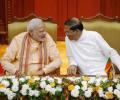
'What we have heard from the Sri Lankans is their desire to have a foreign policy that allows Sri Lanka to best advance its own interests rather than a foreign policy that relied solely on one relationship.' 'We think this is an attitude that makes a lot of sense. India and Sri Lanka have many areas of shared interests, and it's certainly welcomed by us to see that deepening of those ties.'

He said he has always maintained that instead of fighting with each other, India and Pakistan should together fight against poverty.

'We are two countries that, as Swami Vivekananda said in Chicago more than a century ago, have sheltered the persecuted and the refugees of all religions and all nations on Earth.' 'People are watching to wait and see if this Modi moment is going to be the moment when the world's oldest democracy and the world's largest democracy finally capitalise on the full, inherent potential of this relationship.' Aziz Haniffa/Rediff.com reports from the State Department's lunch for Prime Minister Modi.

During the meeting with Acting Deputy US Trade Representative Wendy Cutler on Wednesday,

'One lesson to emerge out of the Modi-Putin summit is that India can be more self-confident that it possesses inherent strengths to leverage its interlocutors to influence Pakistani policies,' says Ambassador M K Bhadrakumar.

'The past year has yielded extraordinary results in the strategic, commercial, and people-to-people components of the India-United States partnership, US Ambassador to India Richard Rahul Verma tells Aziz Haniffa/Rediff.com in an exclusive interview.

Voted to power with an absolute majority for the first time in nearly three decades, India's Prime Minister Narendra Modi, considered as an able administrator, promises "a fresh engagement" with the United States, a latest Congressional report has said.
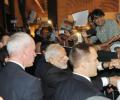
'You can see the essential contours of his new Pakistan strategy. Rather than keep engaging with or humouring them, he'd rather work on taking their four biggest supporters -- the US, China, the UAE and later Saudi Arabia -- away from them.' 'In his calculation,' says Shekhar Gupta, 'with the total support of all four of these, Pakistan will be forced to moderate its policies.'

'The domination of American foreign policy by the military poses some hidden dangers for us.' 'We must factor in that the Pakistani military and the US military have close ties going back three generations.' 'Pakistan will find sympathetic ears in the Pentagon against India as the bogey man.' 'This will be further milked to the maximum by raising the ante in Kashmir through its proxies,' warns Colonel Anil A Athale.

'The US wants Modi to succeed because we want India to succeed. For our part, when India thinks of its partners in the world, we want it to think of the US first. That means positioning our country as the preferred provider of the key inputs that can help to propel India's rise.' 'The meeting between Modi and Obama is, and must be, an opportunity for true strategic dialogue -- not a scripted exchange of talking points, but an open discussion of the big questions. What kind of world do we want to live in? What are our true priorities? And most importantly, why does this partnership still matter?'

'The onus is now on China to explain to the world why it feels Pakistan should accompany India on the question of NSG Membership!! China's not so covert help for Pakistan's nuclear weapons and ballistic missile programmes will stand exposed,' says former ambassador G Parthasarathy.

'In the last one year, it looks like there were bad things that didn't take place, and there were good things that didn't take place,' says Rajeev Srinivasan.
.jpg)
Prime Minister Narendra Modi, on his first trip to New York as leader of the world's most populous democracy, will draw perhaps the largest crowd ever by a foreign leader on US soil when he takes the stage on Sunday in Madison Square Garden before a crowd forecast to total more than 18,000 people.

Waking up to death threats and abuse on the social media has become a regular occurrence for the Indian-American education advocate. Nikita Puri reports.

A gunman opened fire on Friday at Fort Lauderdale-Hollywood airport in Florida, causing multiple fatalities, officials said.
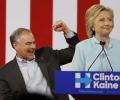
Rediff.com reproduces this 2014 interview with Tim Kaine where in he discusses the new opportunities to foster Indo-US trade and the improvement in ties.

'It is for the first time in 70 years that the US has come out totally in India's favour on the Kashmir issue,' says Colonel Anil A Athale (retd).

'...But my strong suit will not be dancing,' Kal Penn tells Vaihayasi Pande Daniel/Rediff.com, in the concluding part of the interview.

The Indo-US defence relationship may now get personal attention with strong India-backer Ashton Carter today being nominated by President Barack Obama for the key post of the defence secretary.
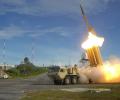
Deployment of THAAD in South Korea could unfold a new cataclysm in the Korean Peninsula with unwelcome prospects.

'Everybody says 5G and communication is important.' 'Everybody says automation, robotics, human computing interfaces -- people and machines working together -- is the future.' 'Everybody agrees that cybersecurity is something that is here to stay.' 'Everybody agrees that synthetic biology is important.' 'Instead of outlining thinking about industries for tomorrow and the future, let the evolutionary pathway be built in a way that it promotes robust, creative, thinking.'
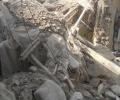
At least eight persons, including three Haqqani network commanders, were killed on Thursday in a rare United States drone strike outside Pakistan's tribal belt, just a day after a top official said the US had agreed to halt such attacks during negotiations with militants.

62 mass murders carried out with firearms across 30 US states. Of these, 12 were in schools, 19 at workplaces, the other 31 cases took place in shopping malls, restaurants, government buildings and military bases. The average age of the killers was 35, with the youngest only 11 years old. B S Raghavan on how the killings will continue until America confronts the urgent need for gun control.

'The Indian government has accepted and is a party to international agreements, standards and conventions on religious freedom.' 'We did not force it on them. We are not trying to impose something on them that they haven't already agreed to...' 'India has never allowed us to visit, which is very disappointing for such a wonderful country with such a rich democratic tradition. They seem to be afraid to let us in.'

Ajay Banga, the 55-year-old CEO of MasterCard, is on a roll.

Ranbaxy, which is 63.5 per cent-owned by Japan's Daiichi Sankyo Co and gets more than 40 per cent of its sales from the United States, did not immediately respond to a request on Wednesday for comment on the FDA observations.

N Sundaresha Subramanian digs deeper into what Catalyst, an Indo-US project, brings to the payments ecosystem.

'Whether it's investments in Kashmir, building naval facilities, or selling top-of-the-range military equipment, Pakistan could well benefit more under Xi's watch.' 'Do Chinese concerns about the 'Islamisation' of Pakistan give it pause about how quickly to move forward with security and economic projects? At the moment the indication is quite the opposite: China is doubling down on its support to Pakistan, partly because of its fears about where the country is headed.'

Pakistan on Saturday accused the US of deliberately trying to sabotage its peace process with militants by carrying out the drone attack that killed Taliban chief Hakimullah Mehsud, saying it would review the entire gamut of bilateral ties and cooperation.

The India that needs strategic alliances, defence cooperation and engaging meaningfully with neighbouring countries is quietly moving ahead with confidence, says Tarun Vijay

Here's a look at the events that shaped the world last week.

'Devyani -- she is a public servant and her personal life has already received far too much attention -- and her ambitious father now need to retreat to the background so that wiser diplomatic heads restore sanity to India-US relations as India prepares for parliamentary elections,' says Ambassador K C Singh.

Hindu-American Congresswon Tulsi Gabbard coasts to a rollicking re-election victory in in Hawaii's 2nd District

'Our approach to India is no different from the approach that we have made in India over the years, recognising its non-aligned status. That's their decision; we're not trying to change that. We have common interests, and we have actually built on those common interests... We think there's more potential to build on those common interests.' 'Security, stability, freedom of sea lanes, economic development, energy, all those are certainly in the interest of India and the region, as they are to the United States.' The transcript of US Secretary of Defence Chuck Hagel's interaction with reporters travelling with him hours before he landed in New Delhi on Friday on a three-day visit to India.

With Beijing having had a profound rethink on India's admission as a full member of the Shanghai Cooperation Organisation, the tectonic plates of the geopolitics of a massive swathe of the planet stretching from the Asia-Pacific to West Asia are dramatically shifting. That grating noise in the Central Asian steppes will be heard far and wide -- as far as North America, says Ambassador M K Bhadrakumar.

'When you see Modi standing there at the G20, or in New York or at the United Nations, amongst all the leaders, he stands out in the crowd.' 'He looks different, he sounds different, and he has something about his quality of presentation, his oratorical skills, which clearly set him apart from the crowd.' 'The relationship between Modi and the rest of the world and India and the rest of the world has been reset as a result of the election in 2014.'
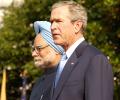
'If we could break through this symbolic barrier of sanctions and a dysfunctional relationship, we could do anything.'

The chief of America's Federal Communications Commission is not a fan of net neutrality. So what's his vision of communications and digital policy in these times?
